
AI Search Visibility Metrics and KPIs: How to Measure AI Search in 2026
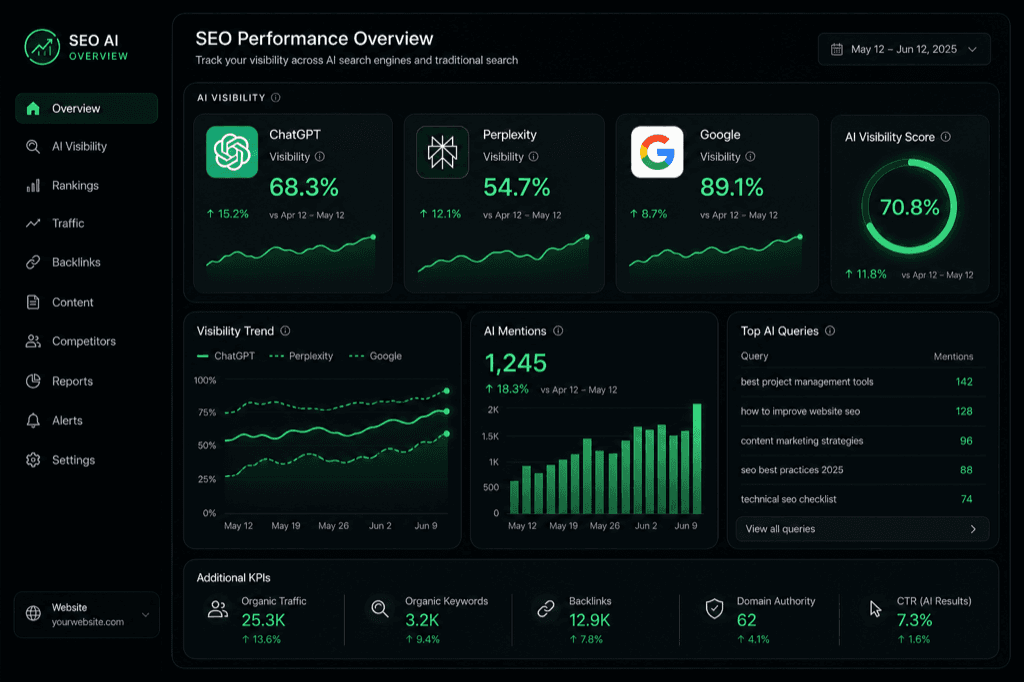
Key Takeaways
- AI search visibility needs 8 KPI layers — from presence and prominence to content readiness and reporting rigor — not just referral traffic
- Track each system separately: ChatGPT, Perplexity, Google AI features, and Claude can return different outputs, while attributable referral performance varies by site
- Readiness observations such as access, clarity, and source attribution belong in a separate appendix; they are not leading indicators with a validated citation effect
- Build reports on fixed prompt sets with engine/date/version logging — without reproducibility, AI visibility data is anecdote, not measurement
A 2026 SparkToro/Similarweb study found that 68% of Google searches now end without a single click. Gartner predicted traditional search volume would drop 25% by 2026 as AI alternatives absorb queries. If your reporting still equates "AI search visibility" with referral traffic in GA4, you are measuring the shadow and missing the object.
AI search visibility metrics and KPIs require a measurement stack that records whether selected answer systems mention your brand, how prominently, which links they show, and whether a resulting visit reaches your site. The framework below has eight outcome and reliability layers:
| KPI Layer | Metric | What It Answers | Formula / How to Measure |
|---|---|---|---|
| Presence | Mention rate | Does your brand appear in AI answers? | Brand-mentioned prompts ÷ total tracked prompts × 100 |
| Prominence | Answer placement | How early does your brand appear? | Position of first brand mention (1st, 2nd, 3rd); first-mentioned competitor |
| Authority | Citation share | Does the AI cite your site as a source? | Your cited URLs ÷ total cited URLs × 100 |
| Competitive | AI share of voice | Who appears more — you or competitors? | Your mentions ÷ (yours + competitor mentions) × 100, per prompt set |
| Perception | Sentiment & accuracy | Is the AI description correct? | Manual or LLM-assisted review: correct / outdated / negative / hallucinated |
| Demand | AI referral traffic | Does AI search send visits? | GA4 source filters for chatgpt.com, perplexity.ai, copilot.microsoft.com |
| Business | Observed conversion evidence | Do attributable visits convert? | AI-referral conversions; test indirect influence separately |
| Reliability | Prompt coverage | Is your data reproducible? | Fixed prompt set with market/language/engine/date/version tags |
Layers 1–5 measure what AI engines show users about your brand. Layers 6–7 measure downstream business impact. Layer 8 ensures the entire framework produces data you can audit and defend.
Why AI Referral Traffic Alone Fails as a KPI
The instinct to start with traffic is understandable — it is the metric marketing teams already know how to read. But traffic records visits, while a mention or linked citation can occur without a click.
A user can see a brand in an answer and never visit its site, so GA4 cannot count that unclicked exposure. On June 3, 2026, Google began rolling dedicated Search and Discover generative-AI Performance reports out to a subset of websites; the announced Search fields include impressions, pages, countries, devices, and dates, while the data remains part of overall Performance. Availability is not universal, and this Google-only view does not measure cross-engine mentions or citations. Output observation and referral analytics therefore still need separate columns.
Indirect influence is harder to attribute. A buyer may read about a product in one place and later arrive through another channel, but that sequence cannot be inferred from aggregate traffic alone. Use controlled experiments or customer research for causal claims; use mention rate and citation share only as sampled exposure metrics.
Track Each AI Engine Separately — One Score Fails
ChatGPT, Perplexity, Google AI features, and Claude expose different interfaces and can return different mentions and links for the same prompt. Their complete selection algorithms are not public, so measure each system separately without inventing universal source preferences.
| Engine | Output to record | Documented discovery control | Referral observation |
|---|---|---|---|
| ChatGPT search | Brand mention, linked source, and answer context | OAI-SearchBot; independent from GPTBot training policy | Inspect chatgpt.com referrals that reach the site |
| Perplexity | Brand mention, linked source, and answer context | PerplexityBot for search discovery | Inspect perplexity.ai referrals that reach the site |
| Google AI features | Whether the sampled Search result includes a linked source | Ordinary Googlebot crawl, index, and snippet eligibility | Included in overall Search Console Performance; dedicated generative-AI views are rolling out to a subset of sites and expose the fields Google documents |
| Claude search | Brand mention, linked source, and answer context | Claude-SearchBot; independent from ClaudeBot training policy | Inspect attributable referrals that reach the site |
The conversion differences make engine-level tracking worth the effort. Seer Interactive’s 2025 analysis of a B2B client found ChatGPT referrals converting at 15.9%, Perplexity at 10.5%, Claude at 5%, and Gemini at 3% — against 1.76% for Google organic. Blending these into a single “AI score” hides which engine actually drives qualified demand.
For competitive tracking, measure AI share of voice per engine and per prompt category:
| Prompt Category | Engine | Your Mentions | Competitor A | Competitor B | Your SoV |
|---|---|---|---|---|---|
| Category queries | ChatGPT | 14 / 20 | 11 / 20 | 6 / 20 | 45% |
| Category queries | Perplexity | 9 / 20 | 13 / 20 | 8 / 20 | 30% |
| Comparison queries | ChatGPT | 8 / 10 | 10 / 10 | 7 / 10 | 32% |
This structure forces engine-specific, category-specific reporting. A brand dominant on ChatGPT but absent from Perplexity needs a different action plan than one with even distribution.
ChatGPT
Cited
Perplexity
Not cited
AI Overviews
Competitor cited
Illustrative sample UI only — MendMySEO does not currently provide production-verified cross-engine citation tracking. View the demo →
Keep Readiness Evidence Separate From Citation KPIs
Layers 1–5 describe sampled outputs. A page audit can separately record access policy, indexability, content clarity, source attribution, and supported structured data. Public documentation does not establish a formula that converts those observations into citation probability.
Source-readiness evidence can cover four practical review questions:
- Contextual clarity — Does the page answer its stated question directly and define important terms?
- Organization — Do headings, lists, and tables reflect the visible content accurately?
- Attribution — Are material claims backed by named, traceable sources and dates?
- Original evidence — Does the page disclose the method, sample, limitations, and owner of any first-party data?
Reputation and source quality still matter to readers, but “domain authority” is not a documented cross-engine citation gate. Use Google's people-first content guidance for its intended Search context and label third-party authority scores as proxies.
Keep readiness findings and citation outcomes in parallel columns. When a citation changes, the data may suggest a hypothesis, but it does not prove which page edit, index change, retrieval system, or answer-generation step caused it.
The illustrative GEO demo is sample UI, not production evidence of per-engine citation tracking, competitor coverage, or ranking impact. Review the current release status; AI citation tracking is not part of the current commercially released Agency claim.
How to Build an AI Visibility Report That Holds Up
A report is only as credible as the methodology behind it. Three structural decisions separate real AI search KPIs from anecdotes dressed as data.
1. Design your prompt set before you start tracking.
Prompts are to AI visibility what keywords are to traditional SEO — the unit of measurement. Categorize them into five types:
| Prompt Type | Example | What It Measures |
|---|---|---|
| Branded | “What is [Brand]? Is it good?” | Brand presence and sentiment accuracy |
| Category | “Best [product category] tools in 2026” | Category visibility and share of voice |
| Comparison | “[Brand] vs [Competitor]” | Competitive positioning, first-mention advantage |
| Problem/Solution | “How do I fix [problem your product solves]?” | Solution-intent visibility and citation rate |
| Local/Industry | “Best [category] for [industry/region]” | Vertical and geographic coverage |
Fix your prompt set at the start of each reporting period. Adding prompts mid-cycle inflates the numbers and breaks period-over-period comparison. Semrush’s AI visibility framework recommends the same discipline: define monitored queries at period start, and annotate any content launches or competitor moves that explain shifts.
2. Structure a monthly report agencies and clients can reuse.
| Report Section | Metrics | Format |
|---|---|---|
| Executive summary | Overall mention rate, top-line SoV, period change | 3-sentence narrative + single KPI with trend arrow |
| Engine breakdown | Mention rate, citation share, sentiment per engine | One row per engine, period-over-period |
| Competitive comparison | SoV by prompt category, first-mention frequency | Side-by-side table with 2–3 competitors |
| Separate readiness appendix | Audited URLs, source observations, changes reviewed | Evidence table; not blended into citation KPIs |
| Traffic & conversions | AI referral sessions, conversion rate by engine | GA4 source table with period comparison |
| Action items | Top 3 priorities for next period | Numbered list with owner and deadline |
For tools that measure sampled AI outputs alongside traditional SEO metrics, see our comparison of SEO reporting tools. Keep that outcome data separate from white-label SEO audit evidence unless the reporting product has production-verified citation collection with a disclosed query set and method. MendMySEO does not currently claim that capability.
3. Know what NOT to report.
- Single screenshots — AI responses vary by session, location, and account. One screenshot is not data.
- Non-reproducible manual queries — A prompt typed once without logging engine, version, date, and location cannot be verified or compared to future results.
- Blended “AI visibility scores” — A single number mixing engines, prompt types, and time periods hides more than it reveals. Break it down by engine and prompt category.
- Mention counts without context — “Mentioned 47 times” is meaningless without: out of how many prompts? Which engines? Which competitors appeared in the same responses?
Tag every data point with engine, date, model version, and prompt category. When a stakeholder asks “how do you know this?” the answer should be a query they can re-run — not a screenshot they have to trust.
Frequently Asked Questions
What metrics matter for AI search visibility?
Eight KPI layers cover the full picture: mention rate (presence), answer placement (prominence), citation share (authority), AI share of voice (competitive), sentiment accuracy (perception), AI referral traffic (demand), assisted conversions (business impact), and prompt coverage with version logging (reliability). Layers 1–5 measure what AI engines show about you. Layers 6–7 measure downstream business effect. Layer 8 ensures reproducibility.
How do you calculate AI search visibility?
The core formula is: brand-mentioned prompts ÷ total tracked prompts × 100 = mention rate. For citation share: your cited URLs ÷ total cited URLs × 100. For AI share of voice: your mentions ÷ (yours + competitor mentions) × 100. Run each formula per engine and per prompt category — never blend into one number.
What is AI share of voice?
AI share of voice measures how often your brand appears compared to competitors across the same prompt set within one AI engine. Run 50 category prompts through ChatGPT: if your brand appears in 20 and Competitor A in 30, your ChatGPT category share of voice is 40%.
How do you track AI citations?
Run a fixed prompt set through each AI engine at regular intervals. For each response, record whether your brand or URL appears, the position of the mention, which URLs the engine cites, and whether the information is accurate. Log engine name, model version, date, and prompt text. Tools like Semrush and manual monitoring workflows both rely on this prompt-set methodology.
Is AI referral traffic enough to measure AI search?
No. Referral traffic captures only visits that reach the site from a recorded referrer. It cannot count unclicked mentions or establish that a later direct or organic visit was caused by an earlier answer. Presence, prominence, citation, and competitive metrics describe a defined output sample; they do not solve causal attribution.
How often should AI visibility KPIs be reported?
Choose a cadence that matches the decision and sample size. More frequent collection costs more and may expose normal output variation; less frequent collection can miss changes. Keep the prompt set and collection context fixed within each comparison period, and disclose any change to the denominator.
Ready to see what your audit looks like?
Explore an illustrative static report; the demo does not crawl the URL you enter.