
Hreflang vs Canonical: How They Work Together (Not Against Each Other)
Key Takeaways
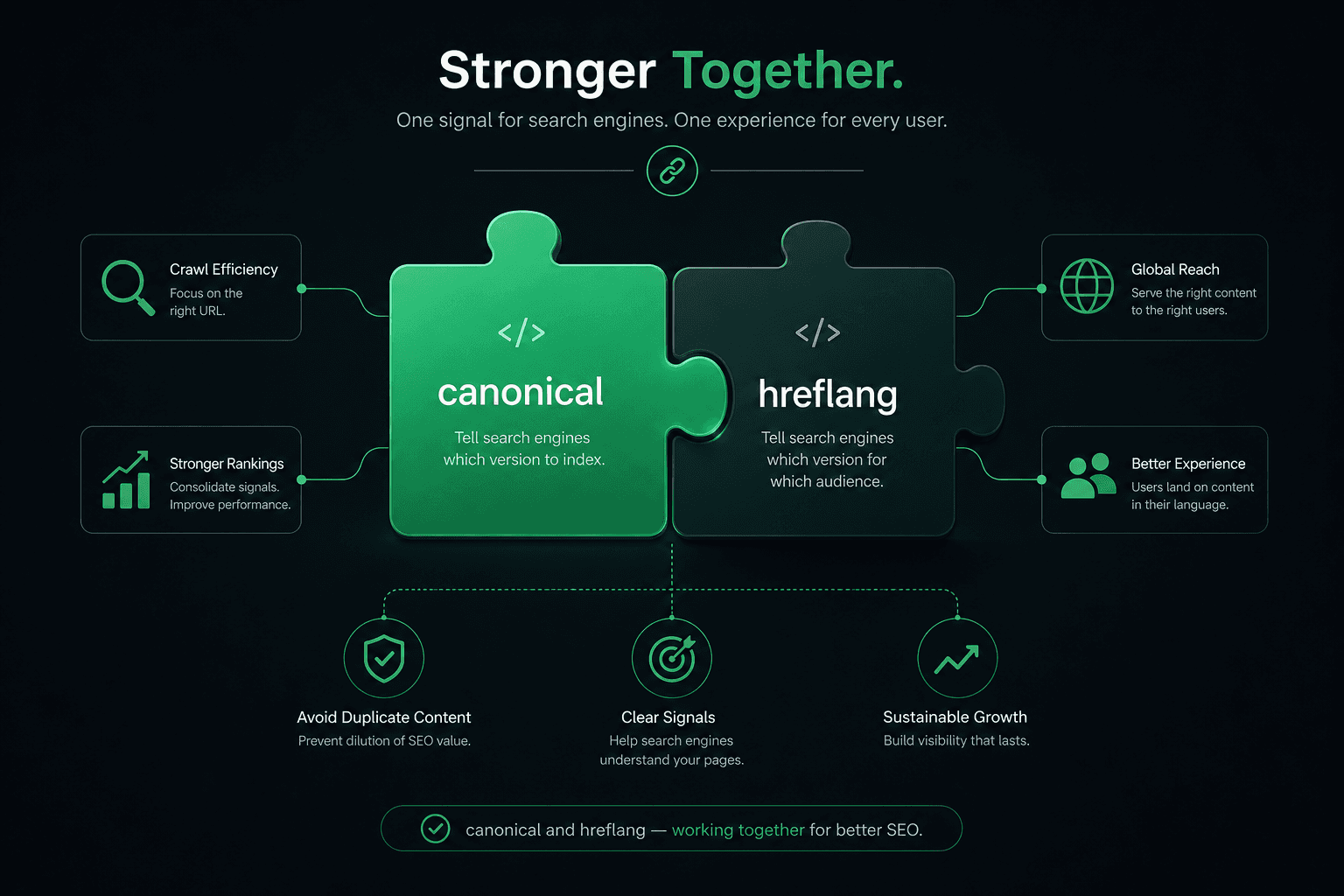
- Hreflang answers "which audience should see this page?" — canonical answers "which URL is the master copy?"
- Hreflang annotations must always point to canonical URLs — referencing non-canonical URLs causes Google to discard the annotation
- Each language version should have a self-referencing canonical (pointing to itself) — never cross-canonicalize between language versions
- The correct pattern: every page self-canonicalizes AND includes itself in its hreflang cluster with a self-referencing hreflang annotation
Should your French product page canonical-point to the English version because the English version has more backlinks? This question reveals the most common misconception about how hreflang vs canonical interact on multilingual sites. The answer is no — and doing so breaks both your canonical signals and your hreflang implementation simultaneously.
Teams conflate these two tags because both appear to deal with "duplicate content." The French page and English page often share similar structure, images, and sometimes near-identical text (for closely related languages). It looks like duplication. It is not. They are language alternatives targeting different audiences — and the tags that handle each case do fundamentally different jobs.
Two Tags, Two Entirely Different Questions
Understanding the distinction prevents every downstream implementation error:
| Attribute | Canonical (rel="canonical") | Hreflang (rel="alternate" hreflang) |
|---|---|---|
| Question it answers | "Which URL should Google index as the master copy?" | "Which URL should Google serve to users of this language/region?" |
| Problem it solves | Duplicate or near-duplicate URLs competing with each other | Wrong language version appearing in a user's search results |
| Signal type | Consolidation — merges ranking signals into one URL | Differentiation — keeps pages separate but targeted to specific audiences |
| Self-reference meaning | "I am the canonical version of myself" | "I am the [language] version of this content" |
| What happens when missing | Google chooses a canonical based on signals (often wrong) | Google guesses which language to serve (often wrong) |
Canonical consolidates. Hreflang differentiates. These are opposite operations. A French page that canonicalizes to the English version tells Google: "the English page is the master; treat my French page as a duplicate." That French page then disappears from French search results entirely — which is the opposite of what hreflang is trying to achieve.
According to Google's documentation on URL consolidation, canonical signals tell Google to transfer all ranking signals (links, content quality) to the canonical URL. Once consolidated, the non-canonical URL stops appearing in results. This is correct behavior for true duplicates (HTTP vs. HTTPS, trailing slash variants) — but destructive when applied to legitimate language alternatives.
The Coordination Rule: Hreflang Must Reference Canonical URLs
Here is where the interaction becomes critical. Google's hreflang documentation requires that hreflang annotations point to indexable, canonical URLs. If the referenced URL canonicalizes to a different URL, Google cannot validate the bidirectional reference chain — because the canonical consolidation has already eliminated the referenced page from Google's index.
The failure cascade:
- Page
/fr/producthasrel="canonical" href="/en/product"(cross-language canonical — already wrong) - Page
/en/producthas hreflang pointing to/fr/product - Google processes the canonical first:
/fr/productis eliminated as a duplicate of/en/product - Google then evaluates hreflang:
/en/productpoints to/fr/product, but/fr/productno longer exists as an independent page in Google's index - The hreflang annotation is discarded — the bidirectional relationship cannot be confirmed with a consolidated (non-existent) page
The correct pattern for every multilingual page:
<!-- On /fr/product -->
<link rel="canonical" href="https://example.com/fr/product" />  <!-- self-canonical -->
<link rel="alternate" hreflang="fr-FR" href="https://example.com/fr/product" />  <!-- self-hreflang -->
<link rel="alternate" hreflang="en-US" href="https://example.com/en/product" />
<link rel="alternate" hreflang="de-DE" href="https://example.com/de/product" />

<!-- On /en/product -->
<link rel="canonical" href="https://example.com/en/product" />  <!-- self-canonical -->
<link rel="alternate" hreflang="en-US" href="https://example.com/en/product" />  <!-- self-hreflang -->
<link rel="alternate" hreflang="fr-FR" href="https://example.com/fr/product" />
<link rel="alternate" hreflang="de-DE" href="https://example.com/de/product" />
Every language version self-canonicalizes (declares itself as the master). Every language version participates in the hreflang cluster as an equal peer. No page points its canonical to a different language version.
Three Scenarios Where Teams Get the Interaction Wrong
Scenario 1: Cross-language canonical to consolidate "thin" translations. A site has 20 pages fully translated into French, plus 80 pages that are auto-translated with minimal quality. The team canonicalizes the 80 low-quality French pages to their English originals, thinking this prevents "thin content" issues. Result: those 80 pages cannot participate in hreflang — French users searching for those 80 topics see the English version or nothing.
Better approach: either improve the translations to stand on their own merit (and self-canonicalize), or do not create the French URLs at all — remove them from the sitemap and from all hreflang clusters.
Scenario 2: Parameter-based language switching with a single canonical. A site uses example.com/product?lang=fr for French and example.com/product?lang=en for English. The canonical for all variants points to example.com/product (no lang parameter). All hreflang annotations then reference the parameter-based URLs — which are non-canonical. Google discards them.
Better approach: use separate URL paths (/fr/product, /en/product) where each self-canonicalizes. If parameters are unavoidable, the canonical must match the hreflang URL exactly — meaning each parameter variant self-canonicalizes.
Scenario 3: Migrating to a new URL structure without updating hreflang targets. Pages move from /fr/produit-ancien to /fr/produit-nouveau. The old URL 301-redirects to the new one. The new URL correctly self-canonicalizes. But other language versions' hreflang annotations still reference /fr/produit-ancien — a URL that now redirects. Google evaluates the hreflang against the declared URL (the redirect source), not the destination. The annotation breaks because the referenced URL is not a canonical, indexable page.
Better approach: update all hreflang references across all language versions whenever a URL changes. Use the XML sitemap hreflang method to centralize these references — one file update propagates the new URL to all annotation relationships.
The illustrative MendMySEO demo may show canonical/hreflang evidence and guidance, but it is not a complete automatic-detection or production-availability claim. Review the current release status.
Frequently Asked Questions
Can two pages have the same canonical but different hreflang annotations?
If two pages share the same canonical URL, they are duplicates in Google's eyes — only the canonical version will be indexed. Hreflang annotations on the non-canonical duplicate are ignored because that page does not exist independently in Google's index. Each page that participates in a hreflang cluster must be independently indexable with a self-referencing canonical.
Should I use canonical or hreflang for regional English variants (US vs UK)?
Use hreflang with region codes (en-US, en-GB). These are not duplicates — they target different audiences with potentially different spelling, pricing, or legal content. Canonical would consolidate them into one version, removing the other from search results. Hreflang keeps both indexed and serves each to its target market.
What if my CMS automatically adds cross-language canonicals?
Override it immediately. Some older CMS configurations and translation plugins default to canonicalizing all translations to the "source" language page. This is the single most destructive misconfiguration for multilingual SEO — it tells Google to deindex all your translated pages. Verify that every language version self-canonicalizes before adding hreflang annotations.
Does Google always respect the canonical when it conflicts with hreflang?
Canonical is a strong signal but still a hint — Google may choose a different canonical based on its own analysis. However, when canonical and hreflang conflict, Google typically processes the canonical first (consolidating duplicates) and then evaluates hreflang on whatever pages remain. In practice, a cross-language canonical effectively removes the target page from hreflang processing. Do not rely on Google "figuring it out" — make the signals consistent.
Is it safe to canonical paginated pages across languages?
Paginated category pages (page 2, page 3) should canonical to themselves within their own language version — /fr/category?page=2 self-canonicalizes. Do not canonical page 2 of the French version to page 2 of the English version (cross-language canonical). Paginated pages should also not carry hreflang annotations — only the primary canonical category page (/fr/category) should be in the hreflang cluster.