
AI SEO Audit: What a Readiness Check Can Actually Prove
Key Takeaways
- A bounded readiness audit can report fetched responses, robots.txt policy, directives, and observable on-page evidence within its declared scope
- Search-discovery crawlers, training crawlers, and user-triggered fetchers serve different purposes and must be reported separately
- Schema, E-E-A-T evidence, headings, and featured snippets are not documented switches that guarantee AI citations
- Actual visibility requires a separate, controlled measurement of mentions and linked citations across defined queries and systems
Your site can pass a technical SEO audit and still be absent from a sampled ChatGPT or Perplexity answer. That does not make the technical findings wrong; it means page evidence and answer outputs are different measurements. The illustrative demo shows bounded audit evidence, not a production citation tracker or a forecast of how often a domain will appear.
A defensible AI SEO audit adds a narrower layer to conventional auditing: it records which search and training crawler rules apply to the sampled URLs and reviews the source material the audit actually fetched. It must not relabel those observations as successful bot access, rendering, indexing, “citation likelihood,” or the reason a model selected a source.
This article maps what a readiness audit can observe, what remains unknown, and when a separate citation measurement is required.
What Crawlers Actually Check — and Where They Stop
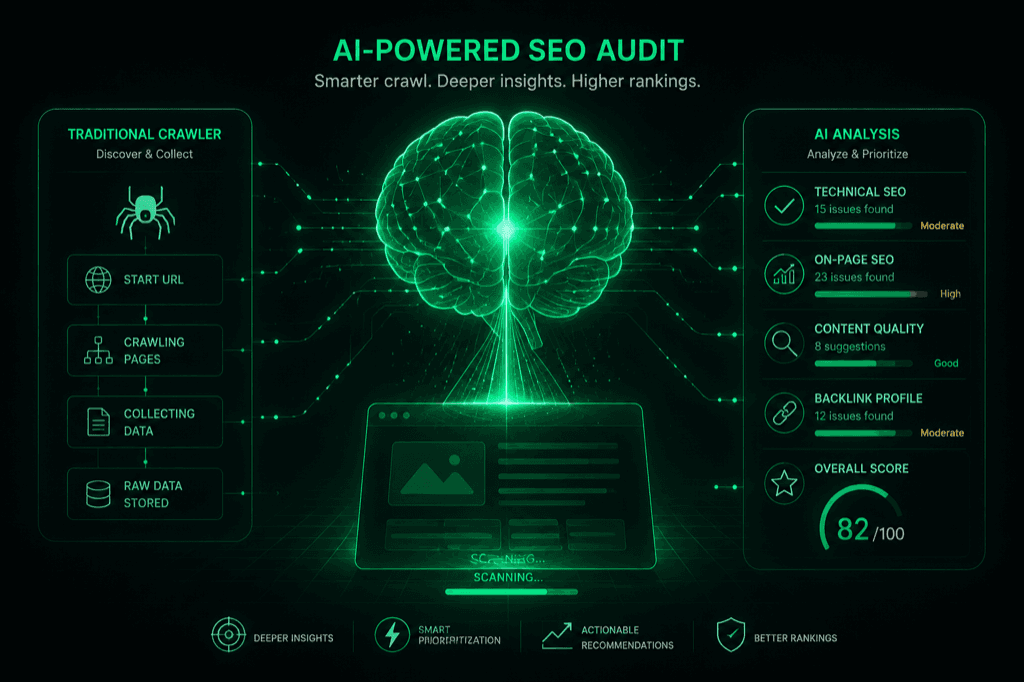
Traditional SEO crawlers (Screaming Frog, Sitebulb, Lumar, Ahrefs Site Audit) are engineering tools. They follow every link on a site, record the HTTP response, and flag deviations from best practices. The checks fall into predictable categories:
| Category | What Crawlers Check | Example Finding |
|---|---|---|
| Technical health | Status codes, redirects, canonicals, robots.txt | "47 pages return 404; 12 redirect chains exceed 3 hops" |
| On-page elements | Title tags, meta descriptions, H1s, alt text | "23 pages missing meta descriptions; 8 have duplicate H1s" |
| Page speed | TTFB, LCP, CLS, FID/INP | "LCP is 4.2s on mobile (threshold: 2.5s)" |
| Indexability | Sitemap presence, noindex directives, crawl depth | "15 pages are noindexed but linked from the main nav" |
| Links | Internal link structure, broken links, anchor text | "Orphan pages: 9 URLs with zero internal links" |
These checks are necessary. A site with 47 broken links, missing canonicals, and a 4-second load time will struggle in any search engine — traditional or AI. Crawler-based auditing catches the infrastructure problems that block visibility at the most basic level.
A crawler can tell you that a page has an H1 tag, 1,200 words of content, three internal links, and a particular robots policy. A separate content review can assess whether claims are clear, sourced, and current. Neither observation tells you whether a language model will cite the page, and Google documents no extra technical requirements or special schema for appearing in AI Overviews or AI Mode.
That boundary matters: page evidence belongs in the audit; citation presence belongs in an outcome measurement.
The Readiness Layer: What an Audit Can Observe
Search-enabled answer products can retrieve live sources and may present mentions or linked citations. Their full selection systems are not exposed to site owners. A responsible audit therefore stays with reproducible observations and clearly labels any sampled answer output.
For Google AI features, the documented baseline is ordinary Google Search eligibility: Googlebot must be able to crawl the page, the page must be indexed, and it must be eligible to show a snippet. Google explicitly says there are no additional technical requirements, no special schema, and no separate AI text file required.
A current AI-readiness section can report three bounded dimensions:
1. Search-crawler robots.txt policy. Evaluate the rule for each sampled URL using the documented user agent: OAI-SearchBot for ChatGPT search, Claude-SearchBot for Claude search, PerplexityBot for Perplexity, and Googlebot for Google Search and its AI features. A blocking rule can restrict that crawler; the absence of one does not prove successful fetching through a WAF, authentication, or other controls, and does not guarantee indexing or citation.
2. Training and grounding policy. Report GPTBot, ClaudeBot, and Google-Extended as separate data-use controls. OpenAI documents GPTBot independently from OAI-SearchBot, and Google states that Google-Extended does not affect inclusion or ranking in Google Search. Blocking training while allowing search is a valid configuration, not a visibility defect.
3. On-page source evidence. Record whether content is accessible, clearly authored, dated where relevant, and supported by traceable sources. Validate structured data only against its documented Search purpose and visible page content. These are content-quality observations, not a prediction that an answer engine will cite the page.
robots.txt blocks AI search crawlers
No Googlebot blocking rule was observed, while OAI-SearchBot and PerplexityBot are blocked for this sampled path. The finding reports robots.txt policy only; it does not test WAF, authentication, rendering, indexing, or answer outputs.
Paste-ready fix
User-agent: OAI-SearchBot
Allow: /

User-agent: PerplexityBot
Allow: /
This finding reports an observable policy for a specific URL; it does not predict an answer-engine citation. See the illustrative audit →
Readiness and Visibility Need Separate Measurements
ChatGPT search, Perplexity, Claude search, and Google AI features expose different answer experiences. Because those outputs can vary by query, date, location, device, and account context, no one-time page crawl provides complete visibility measurement.
For agencies, this creates two distinct deliverables: a readiness audit that records site evidence, and a citation study that samples actual outputs. A report should never use a readiness score to say a client's visibility is zero.
Three reasons to keep the deliverables separate:
- Different evidence. Robots rules and page HTML are reproducible source observations; mentions and links are generated output observations.
- Different denominators. A citation rate is meaningful only for a documented query set, system list, geography, date range, and collection method.
- Different actions. Fix an accidental crawler block when access is intended; investigate citation outcomes without assuming schema or headings caused them.
Technical soundness can support discovery, but it is not a citation guarantee. E-E-A-T is a quality-rater framework, and structured data supports documented Search features; neither should be converted into a proprietary “AI citation probability” without validated evidence.
The practical distinction is between an evidence audit and outcome monitoring:
| Capability | Readiness audit | Citation measurement |
|---|---|---|
| Primary evidence | Fetched pages, directives, rules, and on-page sources | Observed mentions and linked citations for defined prompts |
| Time model | Snapshot of the audited URLs | Repeated samples because outputs can change |
| Can prove | What the site exposed and which policy applied | What selected systems returned during collection |
| Cannot prove | Future retrieval or citation | Complete coverage of every user's answer |
The practical takeaway: an SEO audit can include clearly separated search-crawler, training-policy, and on-page evidence. If the client needs citation KPIs, commission a distinct study with a documented prompt set and sampling method. The AI search visibility metrics guide explains that measurement boundary.
The illustrative MendMySEO demo shows bounded technical and content-oriented findings. It does not establish production release of AI citation tracking or paid white-label access. Review the current release status.
Frequently Asked Questions
What is an AI SEO audit?
An AI SEO readiness audit can record search-crawler policy, training-policy choices, fetched page directives, and source evidence within a declared sample. Unless the method explicitly performs the relevant tests, it does not verify WAF/authentication access, rendering, indexing, or whether an answer engine will select the content.
How is an AI audit different from a regular SEO audit?
A traditional audit checks infrastructure and on-page implementation. An AI-readiness section adds purpose-specific crawler policy and source-evidence checks. Actual citation measurement remains separate because a site crawl cannot observe changing answer outputs.
Do I still need a traditional SEO audit if I do an AI audit?
Yes. Crawlability, indexability, and accurate page content remain the baseline for web discovery. The AI-readiness section adds policy detail; it does not replace technical SEO or guarantee visibility.
What AI search engines should I optimize for?
Start with the surfaces your audience actually uses, then document the relevant access control: Googlebot for Google Search AI features, OAI-SearchBot for ChatGPT search, Claude-SearchBot for Claude search, and PerplexityBot for Perplexity. Measure outputs separately; do not assume the same prompt or page will behave consistently across systems.
Can AI SEO services help with traditional rankings too?
Some fixes, such as removing unintended crawl blocks or correcting invalid markup, address documented Search requirements. That does not establish a ranking lift or citation lift. Evaluate traditional Search outcomes and answer-engine citations with their own before-and-after measurements.
Ready to see what your audit looks like?
Explore an illustrative static report; this demo does not crawl the URL you enter.