
How to Implement SEO Audit Recommendations After the Report Lands
Key Takeaways
- In a poll of nearly 700 SEOs, 56% said fewer than 40% of their recommendations get implemented — the gap is the norm rather than the exception
- A finding is a diagnosis. It becomes work once it names a change, a location, an owner, and a way to check it afterwards
- Route findings by where the change lives — template, content field, server config — rather than by severity, because one template edit usually clears dozens of rows
- Shipping a change and closing a finding are two separate events, and the re-crawl is what separates them
In May 2021, Kristina Azarenko asked SEOs a blunt question on Twitter: on average, how many of your recommendations actually get implemented? Almost 700 people answered. As Barry Schwartz reported at Search Engine Roundtable, 56% said fewer than 40% of their recommendations ever get built, and 82% said fewer than 70% do.
How to implement SEO audit recommendations starts before anyone touches a template. Each finding has to be rewritten as a specific change, in a specific place, with a named owner and a way to confirm it landed. Findings that survive that rewrite get scheduled. Findings that cannot survive it leave the list.
That reads like paperwork until you look at what a typical audit row says. "Thin content on category pages" is an accurate observation and an unassignable one. Nobody can put it in a sprint, because it names no file, no page, no person, and no finish line. Half the implementation gap lives in that sentence structure.
Why SEO Audit Recommendations Stall Before They Ship
Audits are written to be defensible. Whoever commissioned the report will scrutinise it, so each row is phrased as an observation with evidence behind it — the form that survives questioning. Observations survive questioning well. They convert into work badly.
56% of SEOs said fewer than 40% of their recommendations get implemented, and 82% said fewer than 70% do — from a poll of nearly 700 practitioners.
— Kristina Azarenko poll, reported by Search Engine Roundtable, 2021
Run every row through four questions before it enters a plan. What exactly changes? Which file, template, or field holds it? Who has the access to ship it? What check proves it landed? A finding that answers all four is a task. A finding that answers two of them is still research.
Take the thin-content row above. Answering the four questions turns it into something like: rewrite the 12 category descriptions under /collections that run under 80 words, in the CMS category description field, owned by the content editor, checked by re-crawling those 12 URLs and confirming word count and a unique meta description on each. Same finding. Now it fits in a week.
Some rows fail the rewrite twice and keep failing. "Improve E-E-A-T signals" is the usual example — real advice, no location. Drop those rather than deferring them. A deferred row stays on the list, inflates the count, and makes the remaining plan look more daunting than it is. Dropping is a decision you make once; deferring is a habit that quietly doubles the backlog.
How to Implement SEO Audit Recommendations by Where the Fix Lives
The instinct after an audit is to sort by severity and work down. That ordering fails for a mechanical reason: critical findings cluster in server configuration and template code, which belong to the person with the least availability. Sorted that way, the list stalls at row one while eighty rows that an editor could have cleared in an afternoon sit untouched below it.
Sort by where the change lives instead. Four buckets cover almost every audit.
| Where the change lives | Typical findings | Who can ship it | How you verify |
|---|---|---|---|
| Template / theme file | Missing H1, duplicate title patterns, absent canonical, missing schema | Developer, usually one pull request | Re-crawl the URLs built from that template |
| Content field / CMS | Thin pages, empty meta descriptions, weak internal links, wrong headings | Editor or SEO, no deployment needed | Spot-check two pages, then re-crawl the set |
| Server / CDN config | Redirect chains, mixed content, missing HSTS, wrong status codes | Whoever owns DNS and hosting | Request the header directly and read the response |
| Off-site / third-party | Directory listings, review profiles, entity reference targets | Account owner, often marketing | Manual check on the third-party surface |
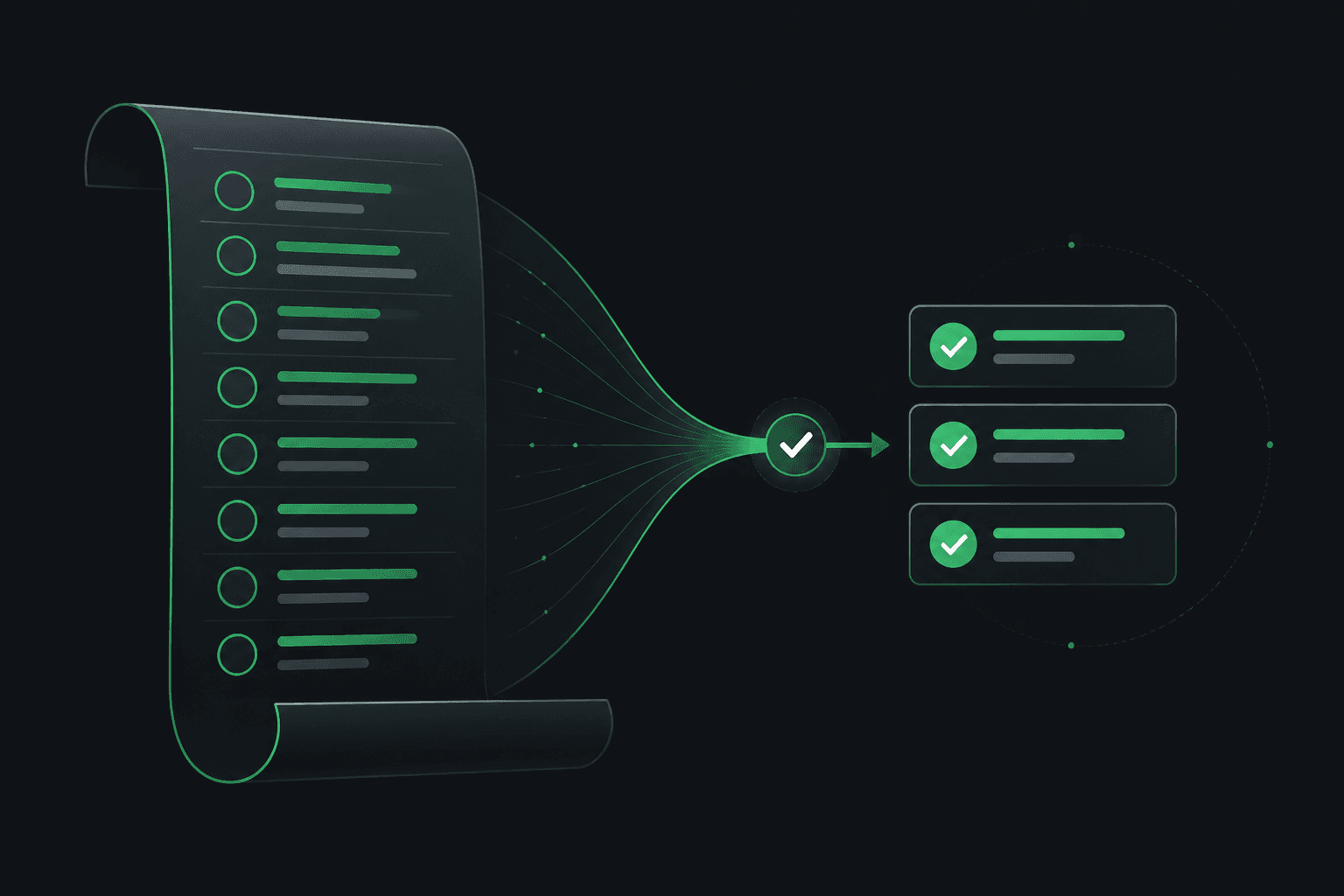
The regrouping does something to the numbers that severity sorting hides. A 200-row report is rarely 200 changes. Duplicate titles across 60 product pages, missing canonicals across the same 60, and absent product schema on all of them are three rows covering one template — one pull request closes all three. Google's own guidance on consolidating duplicate URLs treats this as a single root-cause decision about which URL should represent the set, rather than a page-by-page cleanup, and its crawl budget documentation for large sites makes the same argument at scale: on a big site, per-page remediation loses to fixing the pattern that generates the pages.
Once the rows are grouped, the useful count is changes, not findings. Twenty changes is a plan. Two hundred findings is a document.
Category pages share one title pattern
All 47 URLs under /collections render the same title tag, so Google has no signal to tell them apart. One template edit covers every affected URL.
Paste-ready fix
<title>{{ collection.title }} — {{ shop.name }}</title>
Findings arrive grouped by the file that produces them, with the affected URL count attached. See a full report →
The Re-Crawl Is What Closes a Finding
A shipped change and a resolved finding are different states, and the distance between them is where implementation quietly fails. Four things routinely go wrong after the work is done: a CDN keeps serving the cached old HTML, the change reached staging and never went to production, the template edit covered 40 of 48 pages because eight run on a legacy template, or a plugin rewrote the tag on the next publish.
None of those are visible from the pull request. They are visible from a crawl.
Search Console builds this into its reports. After the fix is live, the issue validation flow re-tests a sample of the affected URLs and reports the result back, moving the issue toward Passed or dropping it back to Failed with the URLs that still break. That second outcome is the valuable one — it names the pages your fix missed. For individual URLs, Google's recrawl documentation covers URL Inspection, along with a caveat worth passing to whoever is waiting: requesting a crawl affects the queue, not the timeline.
Keep two numbers per audit rather than a percentage: how many findings were opened, and how many have been confirmed resolved by a re-crawl. Those two numbers survive a status meeting. "We're about 70% through the audit" does not, because nobody in the room can say what the denominator was.
Set the re-check date when the work is assigned, not after it ships. A change with an owner and no verification date is a change that gets marked done by whoever is tired of looking at it.
The illustrative MendMySEO demo shows findings grouped by the file that generates them, with a re-scan comparing before and after; it is not proof that every finding type is production-covered. Review the current release status — commercial access remains evidence-gated.
Frequently Asked Questions
How long does it take to implement SEO audit recommendations?
Group the findings by where the change lives and the answer usually surprises people. Content-field work clears in days because it needs no deployment. Template work moves at the speed of your release cycle — one pull request, whenever the next deploy goes out. Server and CDN changes depend entirely on access. The honest estimate comes from counting changes and owners, not from counting rows in the report.
Which SEO audit recommendations should I fix first?
Start with the changes that are both high-severity and already owned by someone available this week. That combination beats pure severity ordering, because the highest-severity item on most reports belongs to a developer with a full sprint. Clearing the owned work first also shrinks the report enough that the remaining items get a real conversation instead of a glance.
What should I do with recommendations my developer pushes back on?
Ask which part they are rejecting: the diagnosis, the proposed fix, or the priority. Pushback on the fix is usually correct and worth taking — they know the codebase. Pushback on the diagnosis is answerable with the crawl evidence behind the finding. Pushback on priority is a scheduling conversation that belongs with whoever owns the roadmap, not with you.
Do I need to re-run the whole audit after fixing things?
A targeted re-crawl of the affected URLs answers the immediate question of whether the fix landed. A full re-crawl is worth running after template or server changes, because those have a reach that the original finding may have understated — the same edit that fixed 47 category pages can change canonical behaviour on pages nobody flagged.
Can I implement SEO audit recommendations without a developer?
More than most reports suggest. Everything in the content-field bucket — meta descriptions, headings, internal links, thin pages, image alt text — moves through the CMS. On a mainstream platform, redirects and robots directives are often settings rather than code. What genuinely needs a developer is template markup, structured data, rendering behaviour, and anything in server configuration.