
What Is QA in SEO? Why Systematic Checks Beat Manual Review
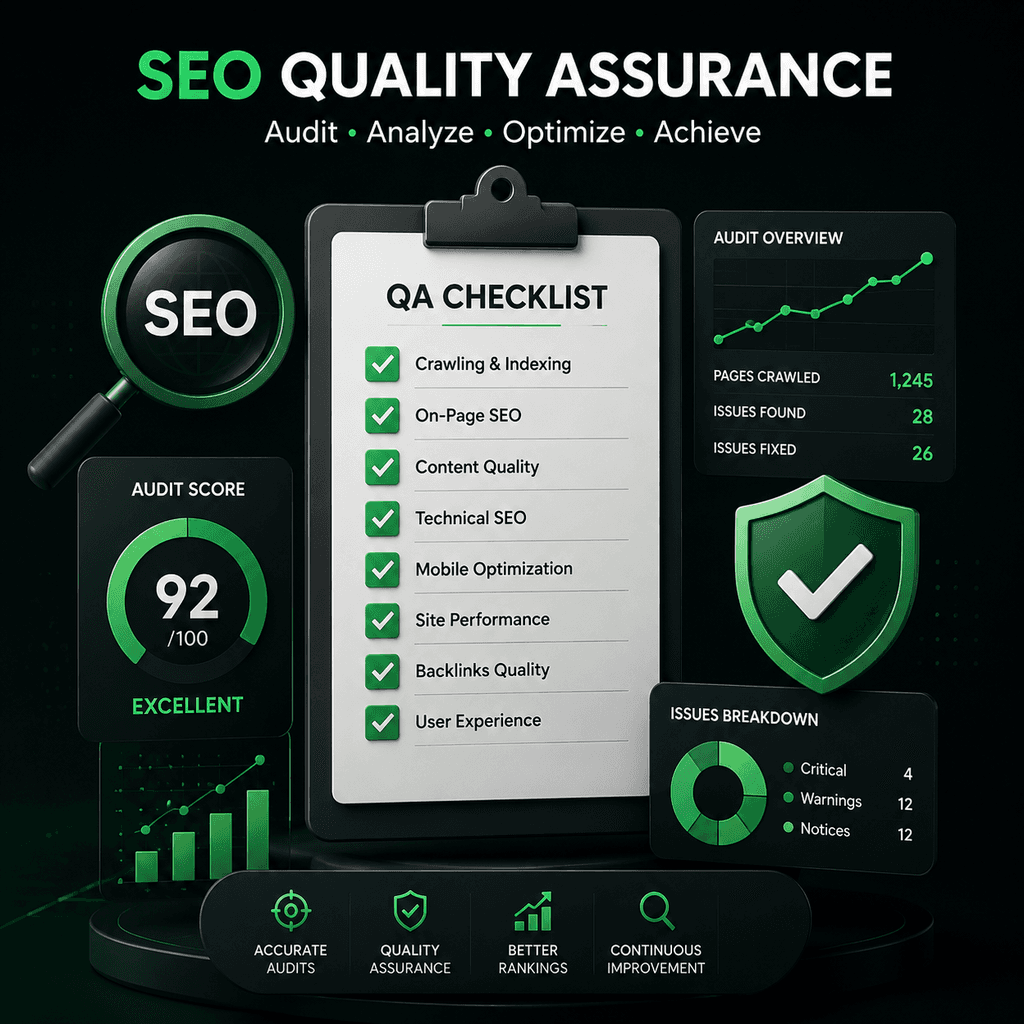
Key Takeaways
- SEO QA is a systematic verification process that catches indexability, schema, and content errors before deployment
- SEO errors are silent — they break search visibility without producing any visible error for users or developers
- QA shifts SEO from reactive ("why did rankings drop?") to proactive ("catch it before deploy")
- An effective QA process runs at four trigger points: pre-deploy, post-migration, content publish, and scheduled audit
A SaaS company launches a site redesign on a Friday. Marketing approves the layout. Engineering runs unit tests — all green. The deploy goes out, everyone goes home. On Monday, organic traffic has dropped 40%. A developer left a <meta name="robots" content="noindex"> tag in the production template header. Every page on the site told Google to de-index it. No alert fired. No test caught it. No one checked.
This is not a rare edge case. BrightEdge research shows that organic search drives 53% of all trackable website traffic. A single misconfigured tag can cut that to near zero overnight — and the damage compounds for every day it goes undetected. QA in SEO (quality assurance) is a systematic verification process that checks for exactly these failures: indexability errors, schema problems, content gaps, and technical misconfigurations that break search visibility without producing any visible error on the page itself.
SEO Errors Are Silent Errors
When a CSS rule breaks, users see a broken layout. When a JavaScript function throws an error, the console logs it. When an API returns a 500, monitoring tools alert the on-call engineer. SEO errors produce none of these signals. A missing canonical tag does not throw an exception. An orphaned page does not trigger an alert. A broken hreflang implementation does not crash anything.
This silence is what makes SEO errors dangerous. They accumulate without detection, and the first symptom is a ranking drop that appears weeks after the error was introduced — by which time the cause is buried under dozens of subsequent deploys.
Common silent SEO errors that QA processes are designed to catch:
| Error type | What goes wrong | How long until detected (without QA) |
|---|---|---|
Accidental noindex | Pages disappear from Google's index entirely | Days to weeks — noticed when traffic drops |
| Missing canonical tag | URL variants split link equity across duplicates | Weeks to months — gradual ranking decline |
| Broken JSON-LD schema | Rich results disappear from SERPs | Weeks — noticed when click-through rate drops |
| Orphaned pages | Pages with no internal links cannot be discovered by crawlers | Months — often never detected without a crawl audit |
| Soft 404 responses | Dead pages return 200 instead of 404, wasting crawl budget | Months — invisible to standard monitoring |
| Missing hreflang on new pages | International pages compete with each other instead of targeting separate markets | Weeks — noticed when wrong language version ranks |
The pattern across all of these: the page looks fine to a human visitor. The error is only visible to search engine crawlers — and by the time Google acts on it, the damage is already done. Manual "spot checks" miss these problems because you cannot see them by loading the page in a browser. QA requires automated, machine-readable verification.
Proactive vs Reactive: When QA Happens Determines Its Value
Most teams discover SEO errors reactively. A ranking drops, someone investigates, they eventually trace it to a technical change deployed weeks ago. The fix goes out, but Google takes days to weeks to re-crawl and re-index the affected pages. Total damage: weeks of lost traffic plus the recovery delay.
QA moves the detection point forward — from "after the ranking drops" to "before the code deploys." The same noindex error that costs three weeks of traffic when discovered reactively costs zero when caught in a pre-deploy check. The fix is trivial in both cases (remove the tag). The difference is entirely about when the check runs.
This is the same principle that software engineering solved decades ago with CI/CD pipelines: run tests before merge, not after production breaks. SEO QA follows the identical logic. The checks are different — instead of unit tests, you verify indexability, schema integrity, internal link coverage, and meta tag configuration — but the pipeline structure is the same: automated checks run at specific gates, and failures block deployment.
Noindex Detected on Production Page
Page contains <meta name="robots" content="noindex"> — Google will remove this page from search results within the next crawl cycle.
Paste-ready fix
<meta name="robots" content="index, follow" />
Indexability audit catches noindex, nofollow, and robots.txt blocks before they remove pages from search. See a full report →
The Four Trigger Points for SEO QA
A QA checklist sitting in a wiki is not QA — it is documentation. QA becomes real when checks execute automatically at specific moments in the development lifecycle. Four trigger points cover the scenarios where SEO errors are most likely to be introduced.
1. Pre-deploy. Before any code change reaches production, run an automated crawl of the staging environment. Check for: new noindex tags, removed canonical tags, broken internal links, changed URL patterns, missing schema on new page templates. This is the highest-value gate because it catches errors before they affect live traffic. Tools like Lumar and CI-integrated crawlers can run these checks as part of the deployment pipeline.
2. Post-migration. After a domain move, CMS migration, or major redesign, run a full-site crawl comparing the new site against the old. Check for: redirect coverage (every old URL should map to a new one), status code changes (pages returning 404 that previously returned 200), canonical consistency, and hreflang completeness. Post-migration QA is non-negotiable — migrations are the single most common source of catastrophic SEO failures.
3. Content publish. When a new page or blog post goes live, verify before promotion: page returns 200, canonical is self-referencing, title and meta description are populated, schema is valid (test with Google's Rich Results Test), and at least one internal link points to the new page from an existing page. Without that last check, the new page is orphaned — Google cannot discover it through crawling.
4. Scheduled audit. Run a full site-wide audit on a recurring schedule — monthly for sites under 10,000 pages, weekly for larger sites. This catches drift: pages that accumulated errors through gradual content edits, CMS updates that changed default settings, or expired SSL certificates. Scheduled audits find the problems that no single deploy introduced but that compound over time.
The illustrative MendMySEO demo shows bounded findings and guidance; it does not prove an 80-check-per-page claim, every QA trigger, or production availability. Review the current release status.
Frequently Asked Questions
How is SEO QA different from a regular SEO audit?
An SEO audit is a one-time assessment of a site's current state. SEO QA is an ongoing process integrated into the development workflow. Audits find existing problems; QA prevents new ones from reaching production. Both are necessary — audits provide the baseline, QA maintains it.
Who should own the SEO QA process?
Ownership depends on company size. In small teams, the SEO specialist defines the checks and engineering integrates them into the CI/CD pipeline. In larger organizations, a dedicated SEO engineering or "technical SEO" function typically owns the QA process, with checks running automatically without manual gatekeeping.
Can I automate SEO QA entirely?
Most checks can be automated: indexability, status codes, schema validation, canonical presence, internal link coverage, page speed thresholds. Content quality checks — keyword targeting, intent alignment, thin content detection — still benefit from human review but can be semi-automated with rule-based scoring.
What is the minimum SEO QA checklist for a small site?
Five checks cover the most damaging errors: (1) no accidental noindex or nofollow tags, (2) every indexable page has a self-referencing canonical, (3) no broken internal links, (4) JSON-LD schema validates without errors, (5) every page is reachable within three clicks from the homepage. These five checks prevent the majority of silent SEO failures.
How much does poor SEO QA cost?
The cost is measured in lost organic traffic. If organic search drives 53% of your traffic and a noindex error removes your site from Google for two weeks, you lose two weeks of 53% of your total traffic — plus the recovery delay. For a site generating $100,000/month from organic, that is roughly $25,000 in lost revenue from a single unchecked deploy.