
Why SEO Audits Fail: The Gap Between Findings and Fixes
Key Takeaways
- Audits are graded on findings delivered. Sites are graded on problems resolved. Most audits fail in the space between those two measures.
- In a poll of nearly 700 practitioners, 56% said fewer than 40% of their SEO recommendations get implemented.
- A list of every affected URL is an inventory. The decision usually sits with six or seven root causes underneath it.
- An audit closes when a re-check reports the issue resolved — not when the document is sent.
The audit was good. Ninety-four pages, every issue ranked by severity, screenshots for the ambiguous ones, a summary the client called the most thorough thing they had ever been sent. Four months later, the same eleven issues were live on the same eleven templates.
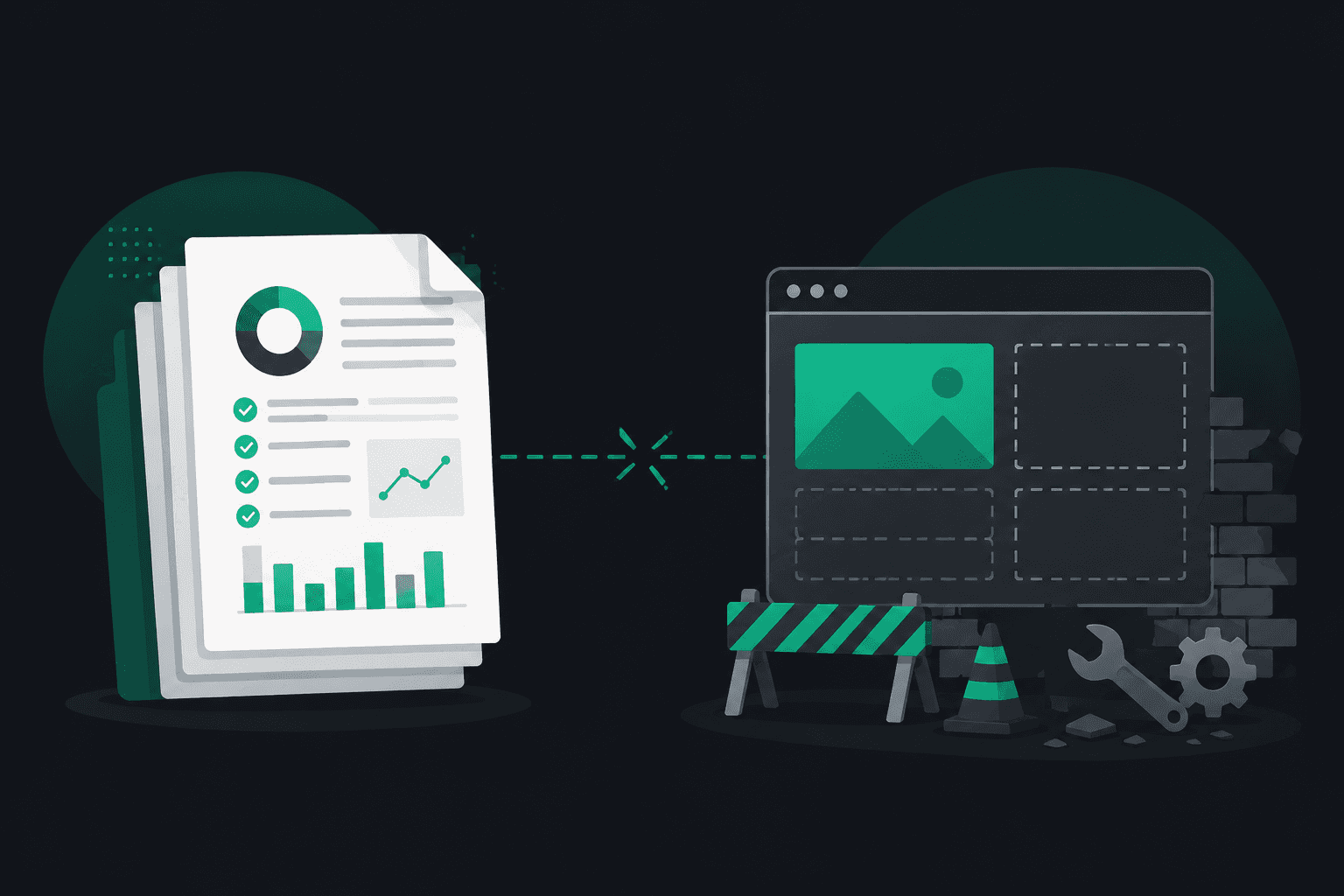
That story is the ordinary case, and it explains why SEO audits fail: the audit is graded on what it finds, and the site is graded on what gets resolved. Those are different measures, and almost nothing in the standard audit workflow connects them. The document ends precisely where the difficult work starts.
The useful consequence of that framing is that the failure stops looking like a talent problem. Auditors who find more issues do not close more of them. Longer reports do not ship faster. What changes the outcome is whether the audit was built to produce decisions and proof, or to produce coverage.
The failure rate lives in implementation, not in the audit
The industry has a habit of treating a missed issue as the cardinal sin of auditing, which is why tools compete on check counts and reports compete on page counts. The measurable failure is on the other side.
56% of SEOs said fewer than 40% of their recommendations get implemented, and 82% said fewer than 70% do — in a poll of nearly 700 practitioners.
— Kristina Azarenko poll, reported by Search Engine Roundtable, 2021
Barry Schwartz covered the poll at Search Engine Roundtable, and the shape of the answer matters more than the exact percentage. A majority of practitioners watch most of their work go unshipped, which means the modal outcome of an audit is a document that changed nothing. If that were a tooling gap, better crawlers would have closed it years ago. We wrote a separate walkthrough of what to do with a finished audit; this article is about why the handoff keeps breaking in the first place.
Once you accept the number, a second question follows: which properties of an audit make its findings shippable? Two answers hold up in practice, and both are structural rather than editorial.
A complete list is an inventory, not a decision
Crawlers report at the granularity they crawl, so a template problem arrives as a per-URL list. One canonical rule applied to a paginated category tree produces 4,000 rows. A developer reading those rows sees 4,000 things to verify. The person who wrote the template sees one decision.
Google's own documentation frames this the way an implementer needs it framed. In the guidance on consolidating duplicate URLs, duplicate handling is described as a single choice about which URL should be the representative one, not as a page-by-page cleanup exercise. The canonical decision is made once and inherited everywhere. An audit that reports it 4,000 times has translated a decision back into an inventory.
The rewrite is mechanical once you see it. Group by cause, name the artifact that has to change, and state the decision the owner is being asked to make.
| Inventory framing | Decision framing |
|---|---|
| 4,182 URLs with a non-self-referencing canonical | The category template canonicalises to page 1. Decide whether paginated pages self-canonicalise, then change one template. |
| 213 images missing alt text | The product gallery component renders alt from an optional field. Decide the fallback, then change one component. |
| 47 title tags over 60 characters | The PDP title pattern appends brand plus category. Decide the truncation rule, then change one pattern. |
| 9 pages with mixed content warnings | Three legacy embeds load over HTTP. Decide replace or drop, then change three embeds. |
Both columns describe the same site. The left one asks a team to process 4,451 items; the right one asks four people to make four decisions. Reports that stall are almost always written in the left column, and the reason is rarely laziness — grouping by root cause requires knowing which template emitted the markup, which is work the crawler cannot do alone.
The illustrative MendMySEO demo groups findings by severity with affected-URL counts attached, which is the raw material this kind of grouping starts from.
Nothing in the standard loop proves the fix worked
Ask an SEO team when their last audit finished and you usually get the date the report was delivered. That is a delivery date, not a completion date, and the difference explains why audit fatigue sets in after two or three cycles: every audit adds to the pile and none of them visibly closes.
Search Console has the closing mechanism, and it predates the current generation of audit tools. The issue validation flow re-tests a sample of affected URLs after you declare a fix and reports back which ones pass and which ones still fail. That is a verdict on a specific claim, produced by the search engine rather than by the person who made the change.
Expectations around timing need the same discipline. Google's guidance on asking for a recrawl is explicit that submitting a URL affects queue position rather than guaranteeing when the change gets picked up. An audit that promises recovery by a date is writing a cheque the crawl schedule did not sign.
Wire those two facts into the audit itself and the artifact changes character. Each finding carries the condition that would prove it resolved, the re-check has a date, and the follow-up meeting opens with a result. Trust survives that loop because the audit eventually produces evidence about itself.
Writing that condition is less work than it sounds, because most finding types have an obvious observable attached. The discipline is deciding it while the finding is being written, when the context is fresh, rather than four months later when somebody asks whether the thing was ever fixed.
| Finding | What proves it resolved | Where the proof comes from |
|---|---|---|
| Pages excluded by a noindex tag | Affected URLs return no noindex directive and re-enter the index | Search Console page indexing report after validation |
| Canonical pointing at the wrong URL | Every URL in the set self-canonicalises or points at the agreed representative | Re-crawl of the affected template |
| Invalid structured data | The item parses with zero errors on live URLs | Rich results test plus the Search Console enhancement report |
| Redirect chains | Each entry URL reaches its destination in one hop | Re-crawl with redirect following enabled |
| Mixed content on a template | No sub-resource on the page loads over HTTP | Re-crawl or a browser console check on one representative URL |
| Missing or duplicate titles | Every URL in the affected set emits a unique title within the agreed pattern | Re-crawl of the affected template |
Notice what the right-hand column has in common: it is always an observation somebody other than the author can repeat. That property is what turns a claim of completion into a fact about the site, and it is the part that a report written purely as a list of problems never supplies.
| Stage | Audit graded on findings | Audit graded on resolution |
|---|---|---|
| Output | Ranked list of issues | Ranked list of decisions, each with an owner |
| Granularity | Per URL | Per root cause, with affected URLs attached as evidence |
| Definition of done | Report delivered | Re-check reports the condition resolved |
| Next meeting opens with | Status update | Which items passed and which still fail |
| Failure mode | Backlog grows, trust decays | Backlog shrinks, disagreements become specific |
None of this makes the underlying work easier. Schema still has to be written, templates still have to be edited, and engineering time still has to be won. What changes is that the argument moves from "was this audit any good" to "did this specific condition clear" — and the second question has an answer.
The current release status is worth reviewing before planning around any of this — commercial access remains evidence-gated.
Frequently Asked Questions
Why do SEO audit recommendations not get implemented?
The common causes are competition for engineering time, findings written at a granularity nobody owns, and the absence of a checkpoint that would prove a fix worked. The first is a prioritisation problem, and the second and third are properties of the audit document that the auditor controls.
Are longer SEO audits better?
Length correlates with coverage, not with outcomes. A 90-page report and a 12-page report can describe the same six root causes; the shorter one is easier to act on. Judge an audit by how many decisions it isolates and how each one would be verified.
How do you know when an SEO audit is finished?
When every accepted finding has been re-checked and reported as resolved or still failing. Search Console's validation flow supplies that verdict for the issue types it covers, and a re-crawl of the affected URLs covers the rest. Delivery of the document is a milestone in the middle, not the end.
Should an SEO audit include fixes or only findings?
Findings alone transfer the hard part to whoever receives the report. Pairing each finding with the artifact that has to change, the decision being asked for, and the condition that would prove it resolved keeps the work moving without requiring the auditor to have commit access.
How often should an audit be repeated if the last one was never implemented?
Re-auditing an unimplemented site mostly reproduces the previous list with a new date. Close the open items first, verify them, and re-audit once the site has actually changed — otherwise the second report inherits the credibility problem of the first.