
sameAs Schema: Meaning, Examples & Common Mistakes
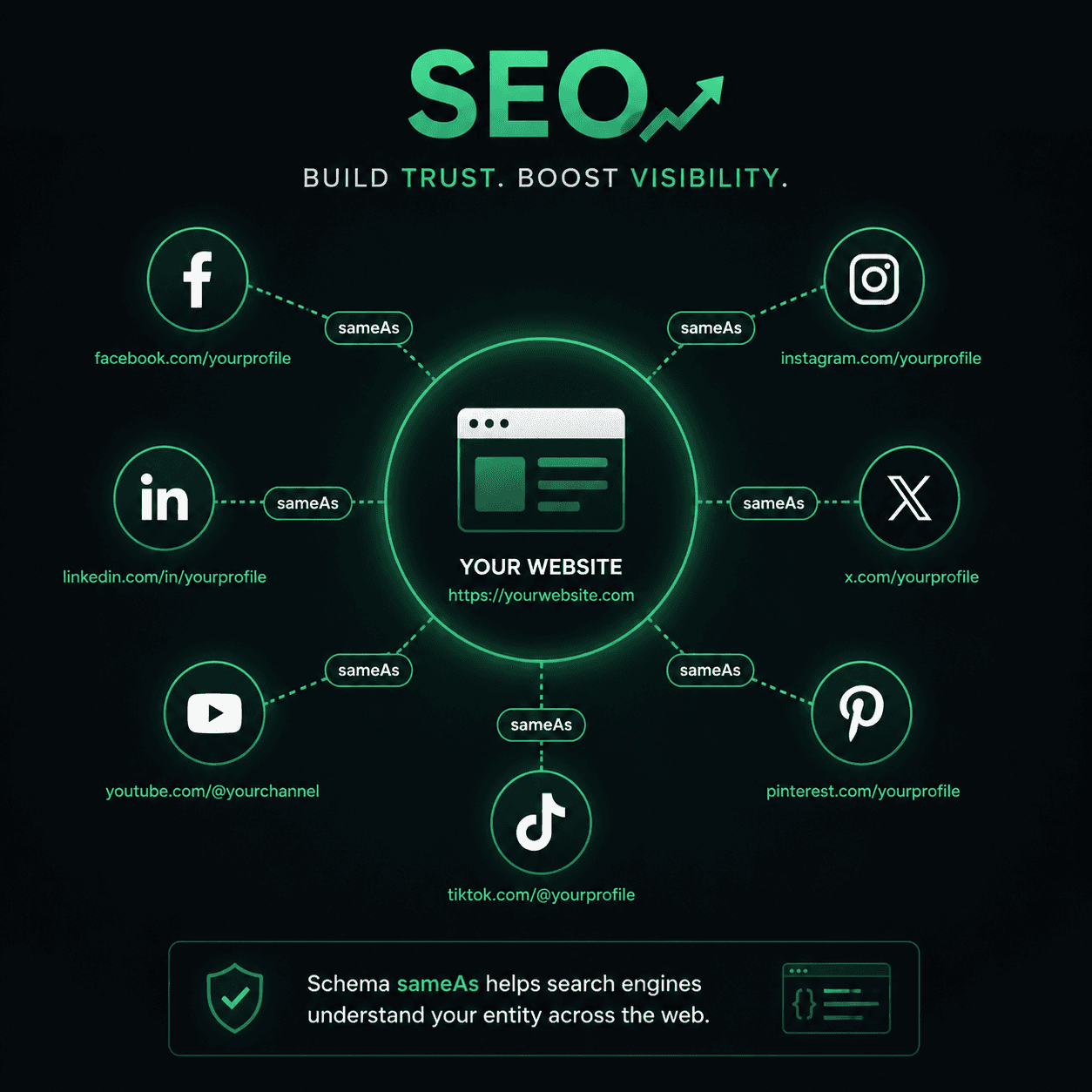
sameAs connects a Schema.org entity to a reference page that identifies the same organization or person. Use official profiles or a dedicated identity page; a page that merely mentions the entity is not enough. It complements a node identifier and its website URL.
Copyable sameAs Examples: Organization and Person
These examples use a fictional business and person. Replace the names and URLs with your own verified details; remove a profile if it does not exist or belongs to someone else.
Organization: official company profiles
<script type="application/ld+json">
{
  "@context": "https://schema.org",
  "@type": "Organization",
  "@id": "https://example.com/#org",
  "name": "Sunrise Bakery",
  "url": "https://example.com",
  "sameAs": [
    "https://www.linkedin.com/company/sunrise-bakery",
    "https://www.facebook.com/sunrisebakery",
    "https://x.com/sunrisebakery"
  ]
}
</script>
Person: profiles belonging to the individual
<script type="application/ld+json">
{
  "@context": "https://schema.org",
  "@type": "Person",
  "@id": "https://example.com/about/#alex",
  "name": "Alex Rivera",
  "url": "https://example.com/about/",
  "sameAs": [
    "https://www.linkedin.com/in/your-name",
    "https://example.org/people/your-name"
  ]
}
</script>
A company LinkedIn page belongs in the Organization node. The founder's LinkedIn profile belongs in the Person node. For how these identifiers connect, see @id vs url vs sameAs with a complete JSON-LD graph.
Which URLs should go in sameAs?
| Candidate URL | Use it? | Identity check |
|---|---|---|
| Official company or individual profile | Yes, when verified | Name, organization/person and visible details identify the same entity |
| Dedicated Wikipedia, Wikidata or professional directory entry | Yes, when accurate | The entry is about this specific entity, not a namesake |
| News story that mentions the company | Usually skip | A mention alone does not establish that the page identifies the same entity |
| Employer's profile on a Person node | No | An employer and employee are different entities; use worksFor for that relationship |
| Product, location or competitor profile | No, for the parent company | Related entities need their own nodes and identifiers |
| Tracking URL, old handle or broken profile | Replace or remove | Prefer the current stable destination, without campaign parameters |
Key Takeaways
sameAsstates that another URL describes the same entity as the node in your structured data- Google recommends
sameAsfor some entity types, but does not document it as a guarantee of Knowledge Panels, ranking, or AI citation - sameAs is an entity disambiguation tool, not a social links widget — every URL must point to a page that represents the same entity
- Use a stable canonical target without tracking parameters, and periodically confirm that it still resolves to the intended profile
A consulting firm may have profiles on LinkedIn, Wikidata, and other platforms. An Organization block can use sameAs to state that those specific URLs describe the same firm. That makes the publisher's structured data more explicit, but it does not explain why a Knowledge Panel appears for one brand and not another.
sameAs in schema markup is a property defined by Schema.org for a URL that unambiguously indicates an item's identity. For example, an Organization node can point to its official LinkedIn company profile. The declaration should be accurate and supported by the target page; no published rule says it grants a Knowledge Panel.
sameAs Is an Entity Disambiguation Tool
Most implementation guides describe sameAs as "where you put your social media links in schema." That is incomplete. A footer link helps users navigate, while sameAs makes a semantic statement about the identity of the described node. Search engines can read both HTML links and structured data; the two formats serve different purposes.
When a name is ambiguous, linking to an official profile can give consumers and machines another explicit reference. Use only pages that clearly describe the same organization or person. This improves the clarity of the data you publish; it does not reveal how any search engine stores or resolves the entity internally.
Targets are not limited to social profiles. The essential test is whether the URL unambiguously describes the same entity:
| Platform | Example URL format | What to verify |
|---|---|---|
| Wikipedia | https://en.wikipedia.org/wiki/Your_Entity | The article is actually about this entity |
| Wikidata | https://www.wikidata.org/wiki/Q123456 | The item identifies this entity and its facts are current |
https://www.linkedin.com/company/your-company | The official company profile resolves without tracking parameters | |
| Crunchbase | https://www.crunchbase.com/organization/your-company | The profile describes the same organization |
https://www.facebook.com/your-page | The page is official and still active | |
| X | https://x.com/your-handle | The account represents the same entity |
| YouTube | https://www.youtube.com/@your-channel | The channel is the entity's official channel |
Schema.org does not define a priority order for the array, and Google does not publish a weighting table for these targets. Include accurate, durable profiles; do not create Wikipedia or Wikidata entries merely to fill a markup field.
What Google Documents — and What It Does Not
Google's Organization structured data documentation lists sameAs as a recommended property and defines it as the URL of a page on another website with additional information about the organization. Recommended means the property can add useful information; it does not mean it is required for or sufficient to trigger a Search feature.
Google does not document a threshold such as three matching profiles, nor a direct path from sameAs to a Knowledge Panel. A sound implementation simply points to the right pages, matches visible facts, and avoids claiming an outcome that cannot be observed from the markup alone.
Keep the linked profiles accurate for users regardless of whether a crawler follows them. If you want to evaluate brand-result appearance, record the actual search result over time; do not infer it from the presence of a property.
Implementation Rules Most Guides Skip
Use the target's stable canonical URL where practical. Redirect variants may still resolve, but tracking parameters, broken links, and obsolete handles make the declaration harder to maintain and verify. Google does not publish an exact string-matching algorithm for sameAs.
Rules for correct implementation:
- Use the canonical URL — visit the platform page, copy the URL from the browser address bar after all redirects resolve. That is your sameAs value
- Prefer the target's canonical form — avoid unnecessary redirect variants where practical
- Match the protocol — all major platforms use HTTPS; never use
http://sameAs values - Do not include UTM parameters or tracking fragments —
https://facebook.com/page?ref=websiteis not the same URL ashttps://facebook.com/page - Only link to pages that represent the entity — a blog post about your company is not a sameAs target; your company's official profile page is
- Update sameAs when platform URLs change — periodically confirm that each value still reaches the intended profile
In JSON-LD, the implementation is an array inside your Organization (or Person, or LocalBusiness) block:
The complete Organization and Person examples are above. Validate your edited JSON with the Schema Markup Validator, then inspect each target profile.
In this example, @id identifies the Organization node within the JSON-LD graph, while sameAs points to external pages about that organization. That is the extent of the observable markup claim.
The illustrative MendMySEO demo may show Organization-schema findings, but it does not establish complete coverage, Knowledge Panel eligibility, or production availability. Review the current release status.
Frequently Asked Questions
Does sameAs directly improve rankings?
No documented rule makes sameAs a ranking factor or a Knowledge Panel trigger. Use it to describe the entity accurately. Measure rankings, Search appearance, and click-through rates separately.
How many sameAs URLs should I include?
Include the official profiles that materially help identify the entity. Schema.org does not prescribe a target count, and Google does not publish a weighting formula. Every URL should resolve to a page that genuinely represents the same entity.
Can I use sameAs for a Person, not just an Organization?
Yes. sameAs works on any Schema.org entity type. For a Person, link to their LinkedIn profile, Wikipedia page, ORCID, Google Scholar, or professional directory listing. The same rules apply: each URL must represent the same individual, not just mention them.
What happens if a sameAs URL is broken or redirects?
A broken target no longer supplies a usable identity reference. Replace obsolete URLs with the current profile and check any redirect destination. Keep the declaration accurate rather than assuming a specific search-engine response to a broken or redirected URL.
Is sameAs the same as adding social links in the footer?
No. Footer links are navigational HTML; sameAs is a semantic property in structured data. Search engines can process both. Neither format, by itself, proves Knowledge Panel eligibility.